


Photo Alchemy
 Photo AlchemyThe workbench
 Collage and montageCut and rebuilt
 African Art FusionWith Simon Shone


 Majestic Panoramas
More collections


Twenty eight collections, and more being added
Photo AlchemyThe workbenchCollage and montageCut and rebuiltAfrican Art FusionWith Simon Shone
African Queen art by Martin Osner: paintings of African women in acrylic and ink, from Eliza and Zinhle to the Tshazile sisters, and one left to commission.
Every original painting in the African Queen collection has found a home. The only one still to come is the eighth sister, and she has not been painted yet.
"The first African woman I painted was Eliza. She was painted for Memoirs of Light, a portrait one and a half metres high, in acrylic and ink on metal. Eliza worked for my parents and brought up my brother and me; she was our second mother. I painted her muted, because I didn't want her to be overbearing, and because quiet colour told her story best. She found a home soon after the show, and that gave me a great deal of confidence.
Not long afterwards I had a piece of aluminium left over from another project, and I don't like wasting. Its shape gave me a choice between a landscape and a portrait, and it felt right for a portrait. After Eliza, I wanted to be flashy. I love reds, oranges, blues and turquoise. I wanted her young, with bold colour and a lot of texture, looking away rather than at you, so that she stayed a little mysterious. South Africa is the rainbow nation: so many cultures, so many languages, so much diversity, and yet the country knows how to come together when it needs to. That is where the colour came from.
I had her face done and most of the background when Peter, one of my good clients, called me on a video call. He said, 'I see there's paint on your shirt. What are you painting?' I turned the camera around to show him. He said, 'I love it. She's mine.' He bought her right off the easel, before she was even finished."
That was Zinhle, and she was the start of the Tshazile sisters.
Prints and originals from this series are sold through Osner Art Gallery, not on this site.
See prints of this seriesTap any picture to see it larger. Nine show on a phone, the whole collection is here on a larger screen.
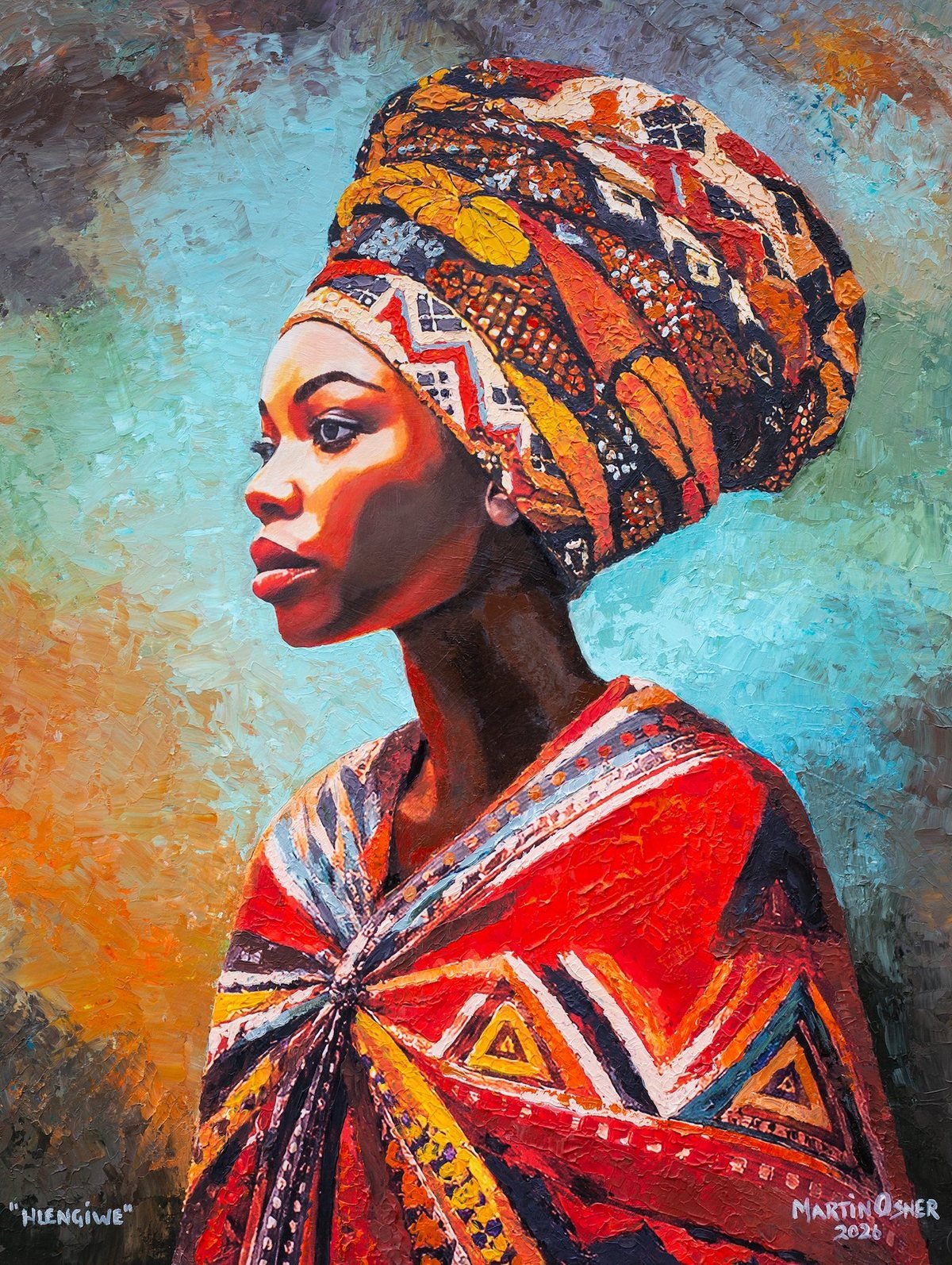
Hlengiwe, finished. Her name is painted on the lower left.
The seventh of the eight Tshazile sisters is finished. Martin laid down the last strokes in the Hout Bay studio, working with a palette knife on aluminium, and her new home is with a collector in Washington State.
Her name is Hlengiwe, chosen by her collector. It means redeemed, rescued, saved.
It had to begin with an H. The sisters' names spell Tshazile, "she who shines", one letter each: Thandiwe, Sibahle, Hlengiwe, Ayanda, Zinhle, Inathi and Lindiwe. That leaves one letter, and one sister.
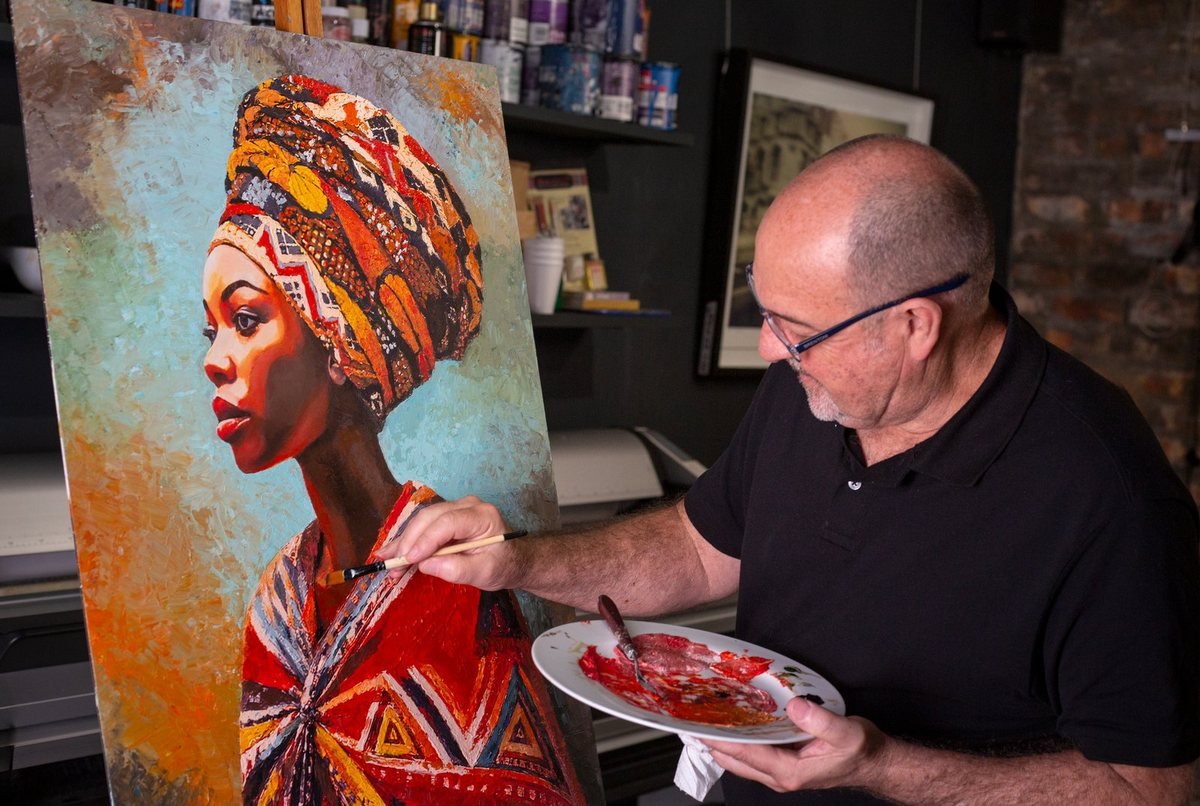
The last strokes, at the easel in Hout Bay.
Zinhle and Thandiwe came out so alike that Martin stood back and said they were twins. When Ayanda was finished she was a sister too, so they became triplets. Then a collector in Australia commissioned a slightly larger piece, and Lindiwe was painted a little older, an elder sister to the three. That was when the family found its name: Tshazile, "she who shines", and each sister's name begins with one of its letters.
 TThandiweSold
 SSibahleSold
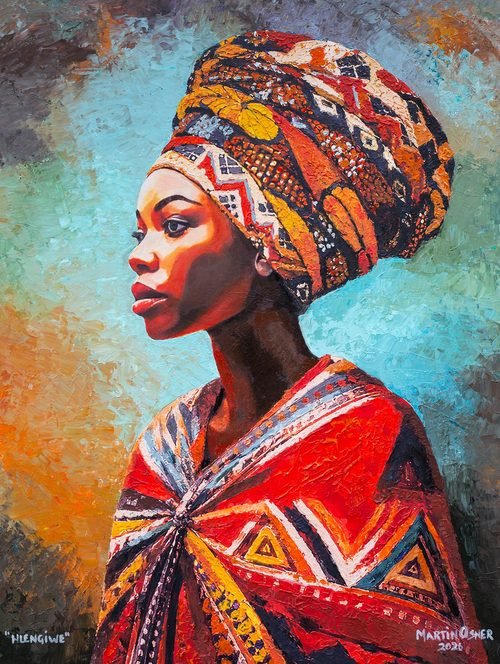 HHlengiweSold
 AAyandaSold
 ZZinhleSold
 IInathiSold
 LLindiweSold
Seven are painted and sold. Sibahle was commissioned before she was painted, and Inathi, the eldest, sold on the opening day of a November show. Hlengiwe, the seventh, was painted for a collector in Washington State, who chose her name. One sister is left, and her name begins with E. Martin will paint her for Impressions of Grace, the exhibition at Osner Gallery in Hout Bay that opens to the public on Saturday 28 November 2026, a celebration of all eight sisters. She will be painted either way, but she can only go to one home. If you would like the last sister to be yours, put your name down now: email info@osnergallery.com or call +27 21 790 6494.
Put your name down for the last sister Read the full story of the sisters

"I painted Timeless Africa just after Lindiwe. I was looking for an almost Moroccan feel in the colours, and I was still painting without eye contact, so I thought: what if we turn the ladies round completely, and create energy in the walking away? The baskets full of produce bring in the idea."
She sold straight off the gallery wall. An art collector from Romania saw her and commissioned a smaller painting in the same style, and a local client in Hout Bay commissioned a horizontal one, with more trees and forest on the right. The first Timeless Africa is now a popular celebration print.


 Nobuhle, The Golden Girls, Purple Reign and Naledi
After Zinhle, Martin wanted eye contact. "I wanted her almost like a gladiator, a fighter, strong in her faith and strong in her tradition." He used far more texture on her, with a granular texture in the background. She sold soon after she was finished, to the same family who own Thandiwe.
Painted on a piece of canvas left over from another work, too good to waste. Martin wanted to move on from Purple Reign while keeping that stylish African look, and the feeling came from a charity ball where his Mandela prints were auctioned: people dressed as if for a wedding, a celebration.
The second African Queen. Naledi was quite literal, with a lot of embedded texture; with Purple Reign Martin went abstract and far more impressionistic, in violet with gold leaf. She stands for African women rising over oppression to become society's new regal figures, and she is a signed limited edition print.
The very first African Queen, whose name means "star" in Sesotho. She came out of a Photo Alchemy workshop Martin was teaching in person: he was showing the students how to create the look with spray paint and liquid glycerine, drawing the hair with sharp tools. He liked what he saw so much that when the students left for the day, he kept working on her until she was right. She is a signed limited edition print.
Zinhle, Nobuhle, Timeless Africa and The Golden Girls all sold soon after they were painted, and most of the Tshazile sisters were commissioned before they existed. A commission is never a copy. It keeps the same style, the same feeling and the same hand, and becomes a painting of its own.

A short film about Purple Reign, the second African Queen. You see the portrait up close, painted in ink and acrylic on fine art paper and finished with gold, and Martin explains why he left the literal, heavily textured look of Naledi behind and went abstract and impressionistic this time. He talks about what she stands for, African women rising over oppression to become society's new regal figures, and why these queens have to be bold, adorned and command their space.
Watch on YouTube
Sold through Osner Art Gallery online, shipped worldwide, and shown in person at Osner Gallery in Hout Bay.
Go to the gallery
Online courses at the Art Photography Academy, live fine art classes on Zoom, and workshops on location.
See the courses


