


Photo Alchemy
 Photo AlchemyThe workbench
 Collage and montageCut and rebuilt
 African Art FusionWith Simon Shone


 Majestic Panoramas
More collections


Twenty eight collections, and more being added
Photo AlchemyThe workbenchCollage and montageCut and rebuiltAfrican Art FusionWith Simon Shone
The painting I made for myself, almost kept for myself, and the one people sought me out to talk about.
There is an interesting tension that exists in the life of a working artist.
Because I teach people how to create art, run a gallery, exhibit my work and carry all the other responsibilities that come with making a living from creativity, I often find there simply isn't enough time left on my calendar to disappear into the studio and create purely for myself.
So when I do manage to clear some space, I want that studio time to be effective.
But what does effective actually mean?
Is it simply about creating a piece of art that I am happy with? Or, as a professional artist, do I also need to consider whether I am creating something that my collectors, gallery patrons and followers will connect with?
It is an ongoing battle, and, considering the painting I am writing about today is called Eternal Shepherd, you will forgive the use of the word eternal.
At any given time I usually have several ideas for new projects floating around in my head. When the opportunity finally comes to begin one of them, I find myself asking: which one should I choose?
Do I begin the artwork that I believe has the best chance of succeeding at my next exhibition?
Do I work within a subject, style or genre that I know has connected strongly with collectors in the past?
Or do I forget about all of that and create something entirely for myself?
That last option is incredibly tempting.
I have always said that we create art because, quite simply, it is good for us. There is something deeply valuable about remaining creative. Studio time gives us an opportunity to find peace and tranquillity in what has become an increasingly rushed, busy and noisy world.
Yet when art is also your livelihood, the economics of being an artist cannot simply be ignored. Bills need to be paid. Staff need to be paid. A gallery needs to operate. A business needs to function.
And so there is inevitably a commercial weight that accompanies creativity.
Perhaps later in my career I will find myself spending far more time creating work that is entirely personal. But for now, these two worlds continue to coexist.
Every now and then, however, I deliberately choose the other path.
 Eternal Shepherd, original painting
When I began this painting I made the decision that I wasn't going to think too much about where it would eventually hang, whether it would work in an exhibition, or whether somebody would want to buy it.
I wanted to create something that was personal.
Something meaningful to me.
Perhaps even something I would hang in my own home.
Interestingly, I don't generally display much of my own work at home. I find greater enjoyment in living with the work of other artists. There is still mystery in their paintings. I don't know every decision they made, every layer they added, or every struggle they had while creating them.
With my own work, I know too much.
I know exactly how it was made.
That somehow changes the relationship I have with it.
But Eternal Shepherd is different.
This is a painting I could quite happily live with every day, because the peace I experience when looking at it goes far beyond the painting itself.
It carries a much deeper spiritual meaning for me.
My father used to say that you are what you think about all day long. I have carried those words with me for a long time, and the older I get the more I believe them to be true, particularly when it comes to the creative process. Whatever occupies your thoughts, your convictions, your deepest beliefs, will inevitably find its way into what you make.
For me that means my faith and my relationship with the Lord Jesus Christ will always influence my work, often when I least expect it. With this painting I wanted to represent Him as a shepherd.
The imagery of the shepherd and his sheep appears repeatedly throughout Scripture, and I have always found it incredibly powerful. Psalm 23 opens with perhaps the best known expression of it:
The Psalm goes on to speak about being led beside still waters, having one's soul restored and being guided along the right path. Later comes another line that became particularly important to me while I was developing the painting:
There is guidance in those words, but there is also protection, trust and an extraordinary sense of peace.
The Gospel of John expresses something similar, and it became central to the finished work.
 INRI, mixed media on linen
 Son of God, with gold leaf
Over the years I have made several artworks out of this belief, each exploring a different aspect of that relationship. Two of them, INRI and Son of God, were created for exhibitions at our gallery, and each approaches the image of Christ in a very different way.
INRI began with a mixed media transfer onto linen, a delicate process that lets the weave of the fabric become part of the image itself. From there I worked into it with layers of paint and mixed media, building atmosphere and depth. The softness of the transferred image against the textured linen gives the work a timeless, contemplative quality, almost as though the image emerged over time rather than being sharply rendered. During the exhibition a number of patrons remarked that it bore a striking resemblance to the Shroud of Turin, a comparison I had never set out to create but found deeply moving.
Son of God takes the opposite path. Here I introduced gold leaf as a central element, and rather than the traditional crown of thorns the gold leaf becomes a crown of glory. The emphasis shifts from suffering to divinity. The leaf catches the light and changes with the angle you stand at, which gives the work a luminous presence that a photograph struggles to carry.
In both of those I portrayed Christ directly. With Eternal Shepherd I wanted to do the opposite.
Instead we see the shepherd from behind, walking away from us with his flock gathered around him.
That decision created some uncertainty while I was painting. I wondered whether people would make the connection at all. Would they simply see a shepherd walking through a landscape with his sheep? For a while I felt perhaps I wasn't doing the subject justice.
But then I began to realise that the mystery was important.
The painting didn't need to explain everything.
The staff became significant. The sheep surrounding and following the shepherd became significant. The way he moves forward into a brighter, almost ethereal landscape became significant.
There was enough.
Perhaps the viewer should be allowed to discover the rest.
The flock moves naturally around and with the shepherd, some close, some a little further ahead, others trailing. What matters is not their precise position but the sense that they belong to him, that they remain under his care, moving forward under his guidance towards the light.
The direction of that light does a great deal of the work. The shepherd and his flock move towards a luminous horizon, which introduces the spiritual suggestion without ever stating it. The light becomes both destination and promise. The gentle rim of light falling around the shepherd's figure separates him from the landscape and quietly reinforces his stature within the scene.
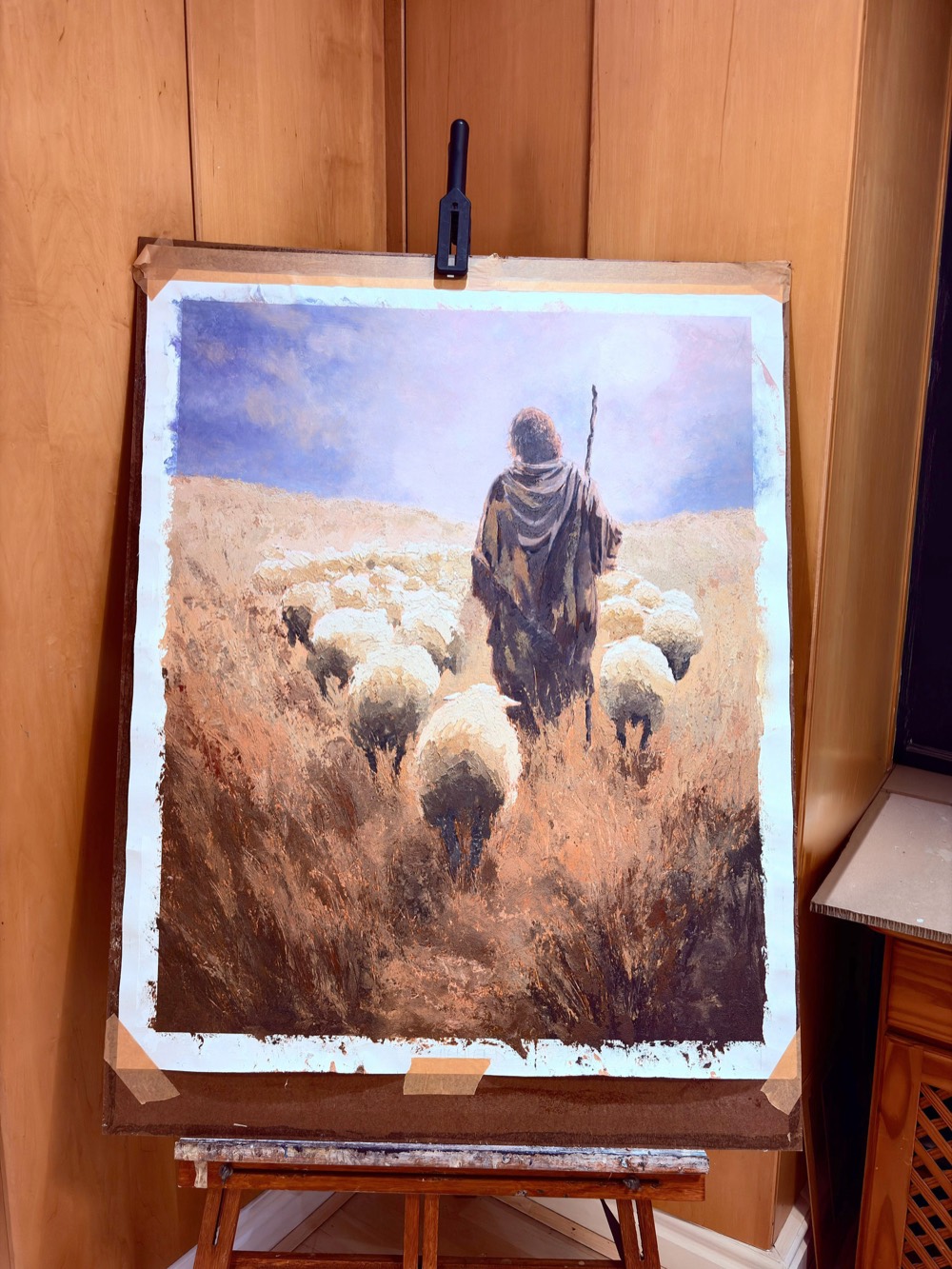
Much of the work was created with a palette knife rather than a brush. I wanted the surface itself to become part of the experience, building thick layers so that the finished painting would carry a genuinely tactile quality.
The painting was built in acrylic impasto, worked up with granular texture paste, then finished with an oil paint overwash and ink. Those last two layers settle the colour and let the light travel across the raised surface rather than sit flat on it.
The texture paste allowed the sheep, the landscape and the surrounding grasses to become physical elements as well as visual ones.
While the knife established most of the atmosphere and structure, I later brought a brush into selected areas to draw certain details out of the paint and guide the eye through the composition.
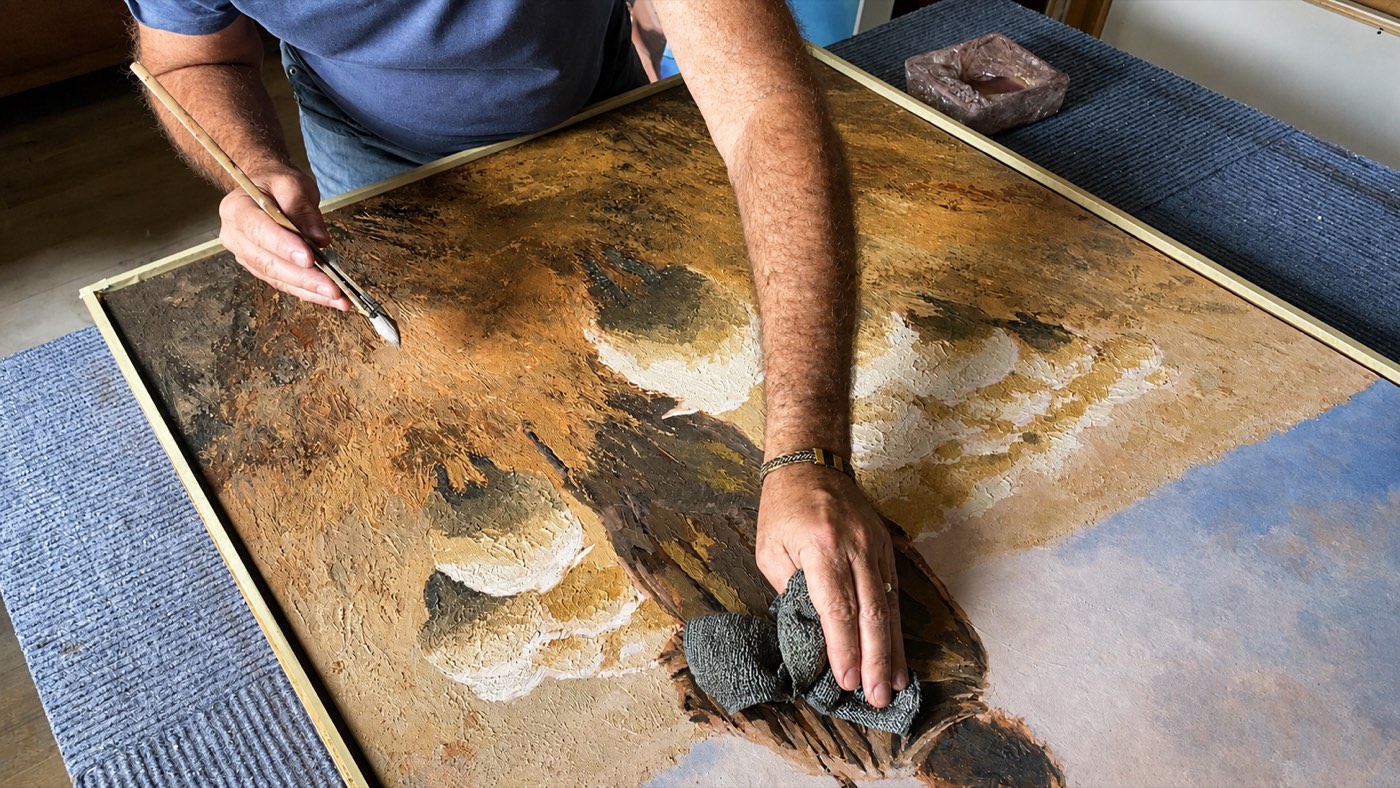 Working into the surface with a brush and a cloth, the canvas laid flat.
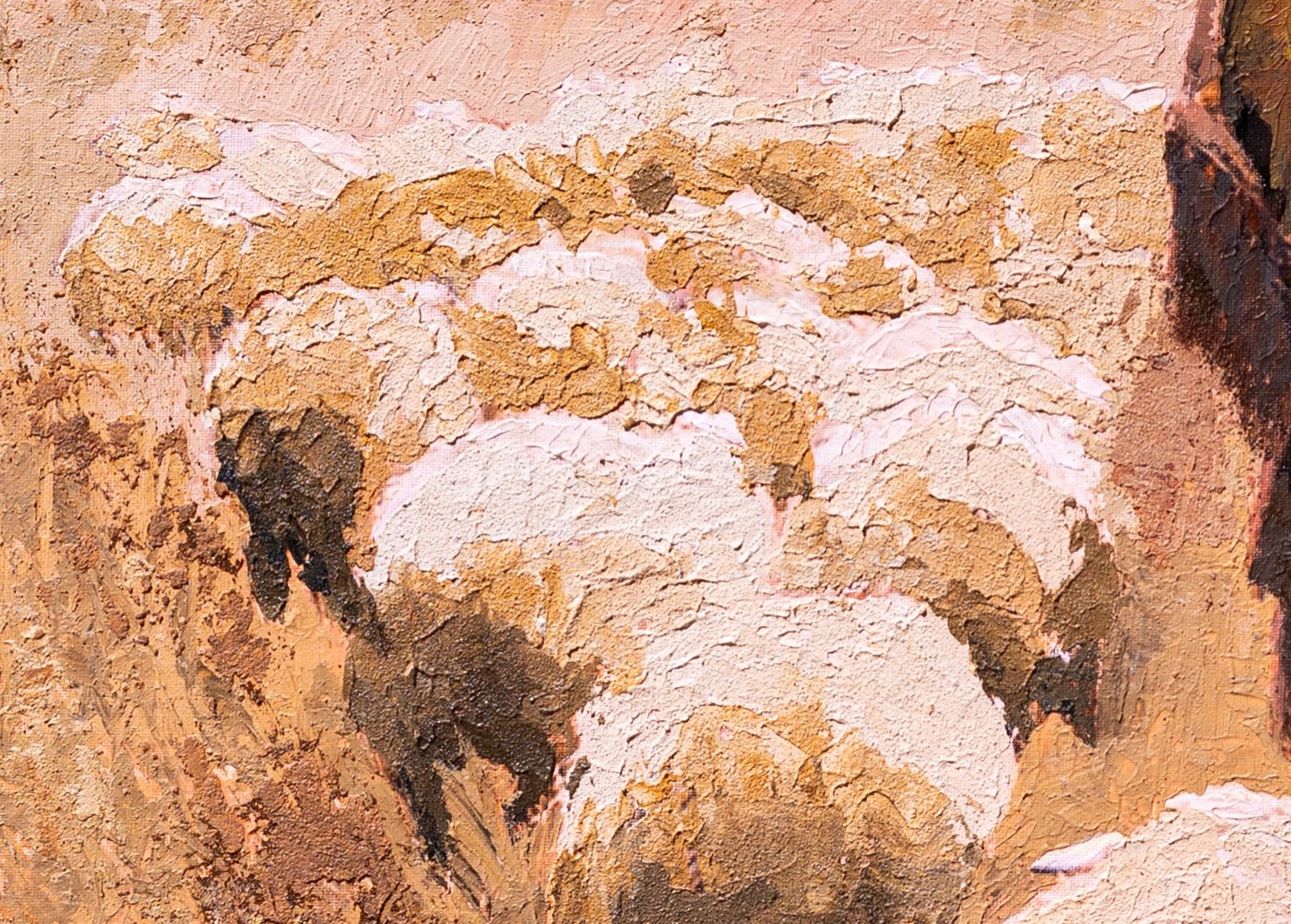 The flock, close up. At this distance the painting is nothing but texture.
One of the challenges I particularly enjoy in a painting like this is the relationship between abstraction and recognition. Standing close, the forms become surprisingly abstract. At that distance it can be difficult to recognise what the painting represents at all. You see marks, edges, layers and texture. Move back and the entire composition makes complete sense, the shepherd, the flock and their movement towards the light resolving immediately and unmistakably.
For much of my career photography was my primary means of expression, and I have often described what came afterwards as having been an artist trapped inside the body of a photographer.
In 2019 I presented my first exhibition of pure painting, Memoirs of Light, featuring a series called Yesterday. Those were large works, roughly a metre and a half in height, and I was genuinely intimidated by the scale and by the commitment of producing a whole exhibition of paintings. Before I started I sat in prayer and asked the Lord to guide me, not only with the hands of a painter but with the mind of one.
Looking back, I believe that prayer was honoured. Last year I spent more time in the painting studio than I did behind the camera, which still surprises me.
Photography has been a solid foundation throughout. As a photographer you develop a deep respect for the characteristics of light, its direction, its quality, the way it reveals texture and form. Those things embed themselves in your way of seeing, and when you pick up a knife or a brush they simply arrive with you at the easel. It is not something you have to think about.
It has also reinforced how important it is to fight for creative time.
Because time very rarely clears itself.
You have to make room for it.
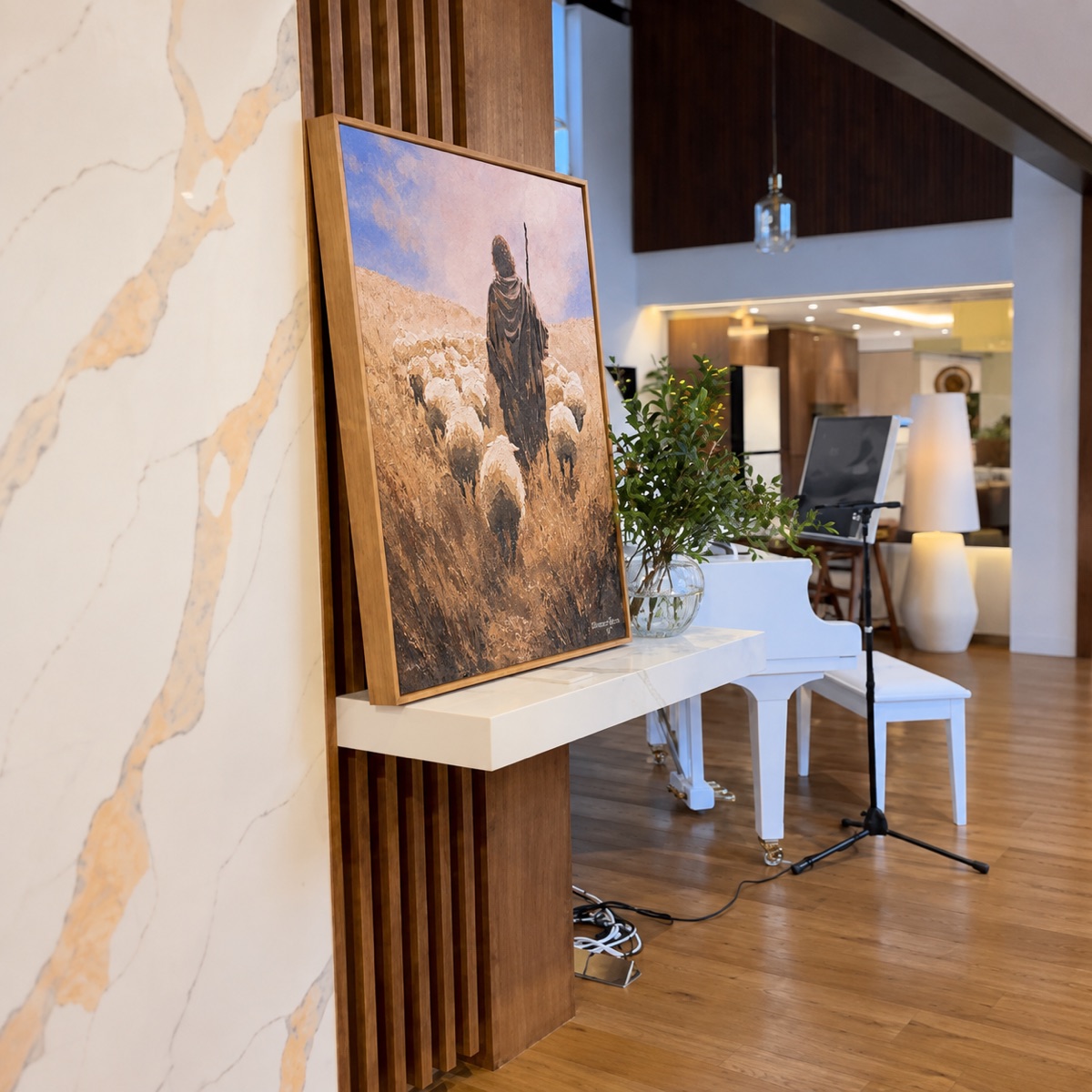
That opportunity arrived in July, when we opened the Echoes of the Earth exhibition at INARA Manor House.
When curator Lyn Mansour came to view the work for the exhibition she immediately noticed Eternal Shepherd. She was quite insistent.
It wasn't necessarily an obvious inclusion. The exhibition had its own theme, and Eternal Shepherd was such a personal work that I was hesitant about putting it out into the world.
But eventually I agreed. Part of me thought it would be an interesting opportunity to see how people responded to it.
We didn't put it in the most prominent position. It wasn't sitting centre stage on an easel demanding attention. It was positioned slightly around a corner, where visitors had to discover it.
And that is what made what happened next so surprising.
During the exhibition people began coming up to speak to me about the painting.
Not one person.
A number of them.
In fact, more people spoke to me about how Eternal Shepherd had affected or moved them than about any other individual artwork in the exhibition.
That took me completely by surprise.
Here was the painting I had worried might be too personal. The painting I wasn't convinced other people would understand. The painting I had originally considered keeping for myself.
And yet it was the work people were seeking me out to discuss.
For me, that was confirmation.
I realised I couldn't keep it hidden away.
Looking back, I probably shouldn't have been quite so surprised. INRI and Son of God had drawn the same kind of response in their time, and they sit alongside the rest of my faith inspired work. Perhaps my hesitation with Eternal Shepherd came precisely because this painting felt so personal.
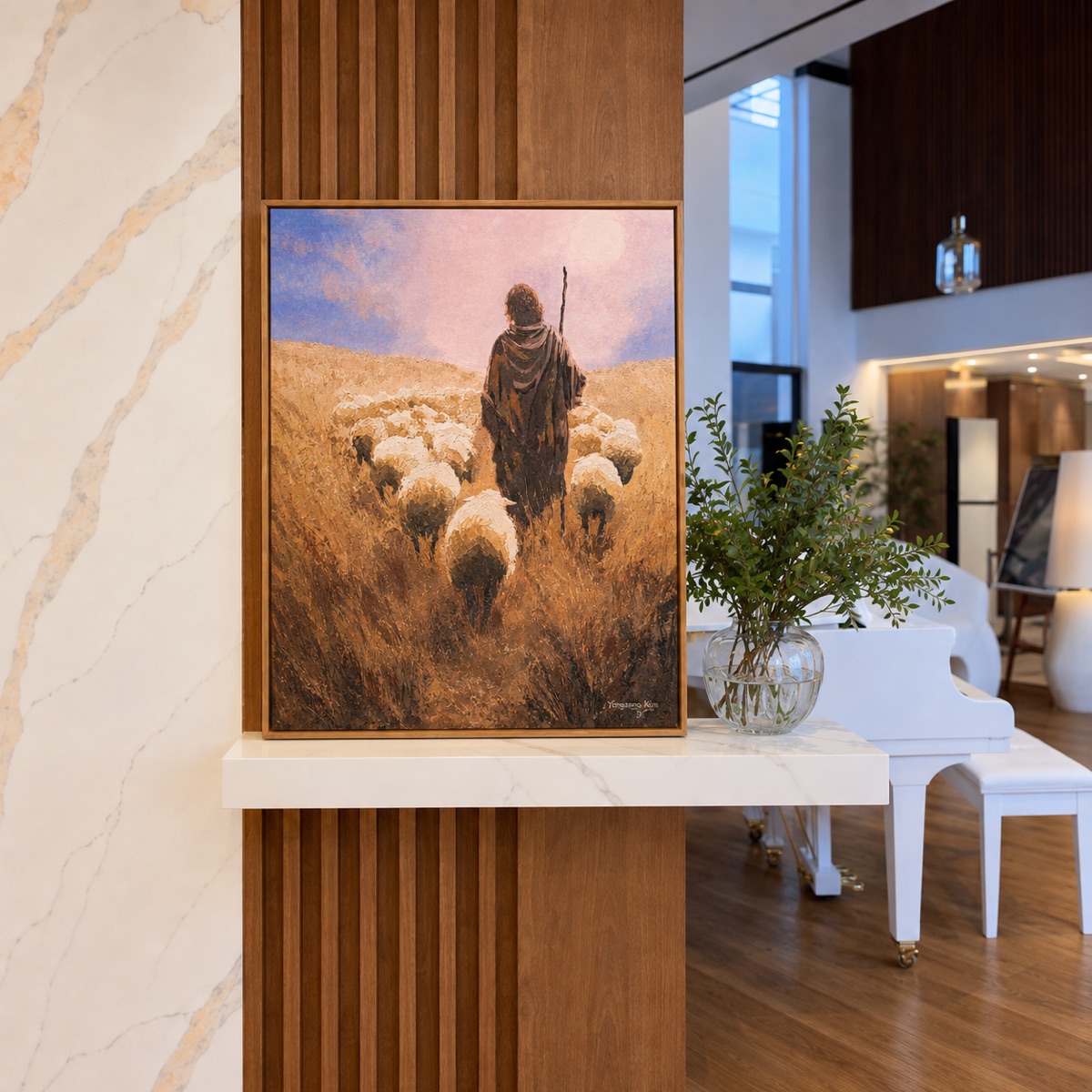 Eternal Shepherd, framed
Eternal Shepherd is on show at Osner Gallery in Hout Bay, and I would love to invite you to come and experience the original.
Come and stand in front of it.
Look at the texture.
Step closer and allow the image to fragment into paint, then move back and allow the shepherd and his flock to appear again.
And see what it says to you.
Because perhaps one of the lessons this painting has taught me is that the work we are most hesitant to share, because it comes from somewhere deeply personal, can sometimes be the very work that connects most strongly with somebody else.
Eternal Shepherd is not intended to provoke theological debate or religious argument. For me it reflects something far simpler and far more personal, the idea of relationship rather than religion. It speaks about trust, guidance and the quiet confidence of walking towards the light under the care of the Ultimate Shepherd.
It means a great deal to me, and it is an honour to share it with you.
Martin Osner

Sold through Osner Art Gallery online, shipped worldwide, and shown in person at Osner Gallery in Hout Bay.
Go to the gallery
Online courses at the Art Photography Academy, live fine art classes on Zoom, and workshops on location.
See the coursesNew work and the stories behind it, exhibitions at the gallery and at INARA, and workshops with Samantha and Martin. Unsubscribe with one click, whenever you like.
We never share your address.