


Photo Alchemy
 Photo AlchemyThe workbench
 Collage and montageCut and rebuilt
 African Art FusionWith Simon Shone


 Majestic Panoramas
More collections


Twenty eight collections, and more being added
Photo AlchemyThe workbenchCollage and montageCut and rebuiltAfrican Art FusionWith Simon Shone
A short road trip to Klaarstroom while visiting Prince Albert led to an unexpected discovery: a forgotten car on a hill, standing silently beneath the Karoo sky.
Sometimes the most important photographs are not the ones you go looking for. They are the ones that find you. That is exactly how Abandoned No.36 came into being, and it is a story I have been wanting to tell properly for a long time.
In September 2015, my family and I were travelling through one of my favourite parts of South Africa. My wife, our three children and I had spent time around Prince Albert before making our way deep into the Swartberg to visit De Hel, or Die Hel, known more formally as Gamkaskloof, a remote valley that had sheltered a small farming community in near total isolation for over a century. Before the 1960s there was no road in or out. People moved on foot, by donkey, on horseback.
It is one of those places one never forgets. De Hel gave me a particular photographic challenge: the valley is so deep that sunlight only reaches the floor late in the morning, and leaves again early in the afternoon. That constraint pushed me into a technique I had not worked with before, multiple exposures in camera, and the film I made there became as much about that creative process as about the place itself.

A Descending Journey to De Hel. The drive down into Gamkaskloof, and how a valley that only sees a few hours of sun led me to multiple exposures in camera.
Watch on YouTubePart of the reason I wanted to spend time in Prince Albert was to catch up with Louis Botha, a former student who had once walked into one of my evening photography classes looking for a way into the creative side of himself. I remember him well. He came with curiosity and a genuine desire to express something, and that kind of student stays with you.
So it was a wonderful moment to arrive and find that he had built a beautiful gallery in Prince Albert and was deeply committed to his photography, producing meaningful work and living the life he had set out to find. As a teacher, there are few things more satisfying than seeing that.
Louis generously shared his knowledge of the area, pointing me towards some remarkable places to photograph in and around the mountains, including his own insights about De Hel. Then, knowing I was quietly working on my Abandoned collection, he suggested I take a drive out to Klaarstroom. He had a feeling there might be something there for me.
The Abandoned collection had always grown this way: unplanned, unforced, sporadic by design. I never went looking for it in any calculated sense. But when someone whose instincts I trusted pointed me in a direction, I took it seriously. There was always a sense that my steps through this collection were being ordered for me, not by me.
 Abandoned No.36
When we arrived in Klaarstroom, I was not immediately convinced. At first glance everything seemed quite ordinary, and I remember wondering whether there was anything there for me at all. Then, almost by chance, I noticed a handful of old vintage cars rusting quietly on a hill.
They were on private property, so I went to find the owner to ask permission, but the house was locked and nobody was home. Still, on my way back down, one composition caught my eye and simply would not let go.
Normally I am no advocate of telephone poles and power lines in a photograph; more often than not they distract. Here they added something important. They gave the image a strange sense of narrative, almost as though the car were still connected to a road, a conversation, or a world that had long since moved on.
I worked very close to the car with a wide angle lens, using deliberate distortion to exaggerate the front of the vehicle and give it presence. I have always felt distortion is one of the most underused qualities in photography: rather than something to avoid, it can become part of the visual language itself. I stitched the exposures together for the feeling of a panoramic capture, while bringing the final image back into the regular horizontal format of the Abandoned collection.
As is my practice, I did not process the files straight away. I left them. Several months passed before I came back to these images, and when I did, this one appealed to me immediately. The car, the open land, the telephone poles, the sky and the stillness of the scene held together beautifully. It became the thirty sixth photograph in the Abandoned collection.
 Abandoned No.1, where it began
 Abandoned No.40, where it ended
That collection had begun many years earlier with a single image of an old car on a pole, a photograph I took without any plan for a series. Slowly, over thirteen years, it grew. I decided from the start not to hunt for abandoned subjects in any calculated or systematic way. I would not research exact locations, plan every outing, or chase images under controlled conditions. Had I done that, the collection would have come together too quickly and, in my view, lost its soul.
The DNA of the Abandoned collection lies in its randomness. These photographs were meant to be stumbled upon in the natural rhythm of my fine art work, found while travelling to photograph landscapes, quiet towns, open spaces and rural scenes. Many possible subjects were left behind because the light was wrong, the season was off, or the atmosphere simply was not there. That waiting became part of the process.
I stopped at Abandoned No.40. Forty felt right. It gave the collection a sense of natural completion, not because there were no more abandoned subjects in the world, but because the journey itself had said enough.
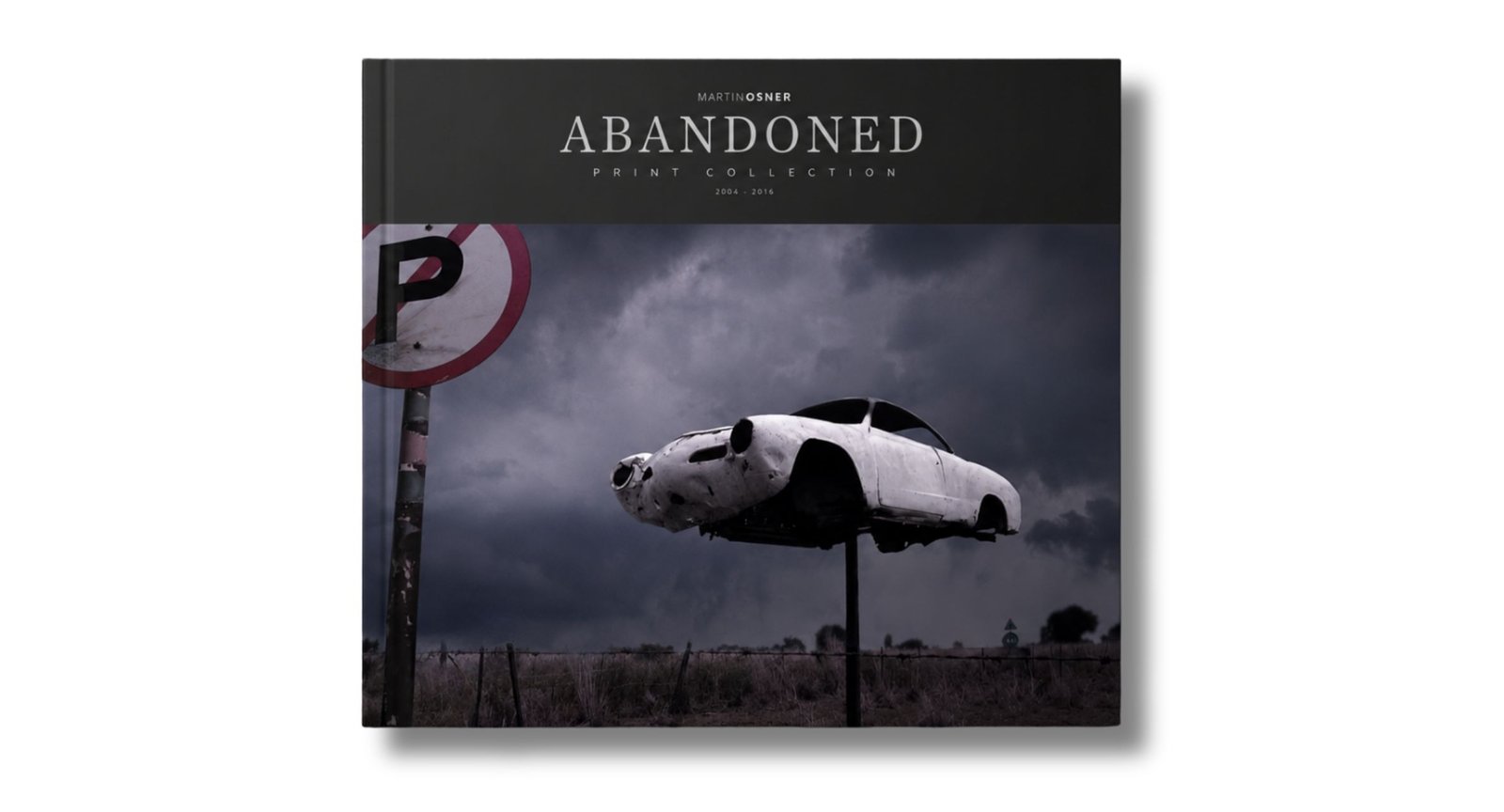
Some time ago I began preparing a coffee table book of the complete Abandoned collection. The project was paused before it reached publication, but I have been thinking about it again, and the timing now feels right.
These forty photographs deserve a beautifully produced book, not simply as a record of old cars, forgotten buildings and weathered places, but as a celebration of a body of work that unfolded slowly, honestly and unexpectedly over many years. Each image carries a story: a journey, a moment of chance, a decision to wait for the right light, or to walk away and come back another day. Together they are something that cannot be rushed, and a book feels like the most fitting way to honour that.
If you would like to be among the first to hear when the book is available, join the letters from the studio at the foot of this page, or simply get in touch.
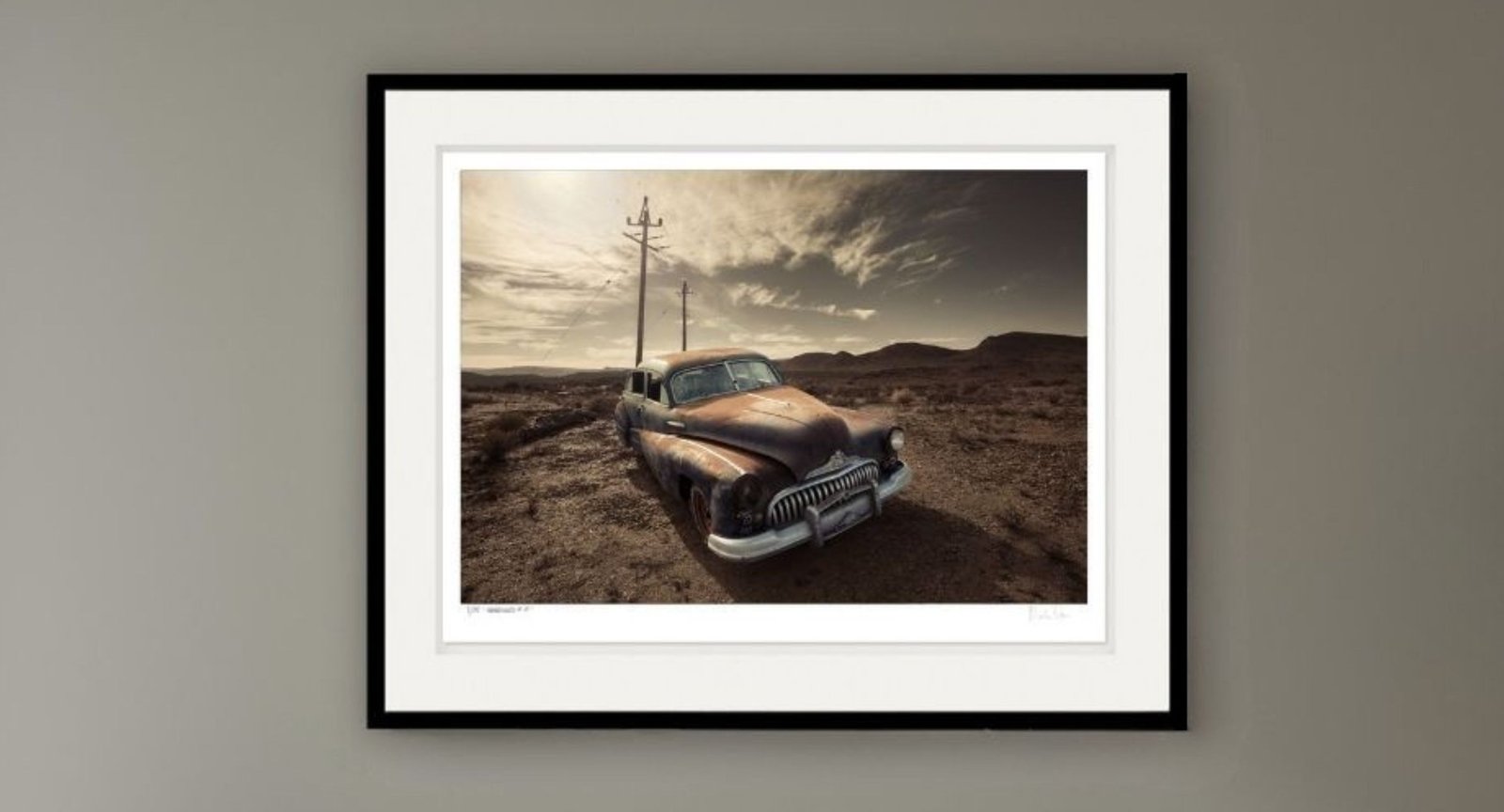 Abandoned No.36, framed
Abandoned No.36 is on exhibition at Osner Gallery in Hout Bay now. Like most of the Abandoned collection, it carries a scale, a detail and an atmosphere that a screen cannot fully convey. Standing in front of it is a different experience altogether, and you are invited to come and see it.
Martin Osner

Sold through Osner Art Gallery online, shipped worldwide, and shown in person at Osner Gallery in Hout Bay.
Go to the gallery
Online courses at the Art Photography Academy, live fine art classes on Zoom, and workshops on location.
See the coursesNew work and the stories behind it, exhibitions at the gallery and at INARA, and workshops with Samantha and Martin. Unsubscribe with one click, whenever you like.
We never share your address.