
When the Lens Becomes a Brush
From weathered fishing boats to leftover paint on scrap paper, discover how photographic montage transforms the lens into something closer to a brush — and the collections that grew from that idea.
STORY BEHIND THE ARTWORKABSTRACT
Martin Osner
4/3/20265 min read
Not every piece of work arrives with intention. Some of the best ones begin quietly — as something else entirely.
The Story behind Analogous Athology No.7
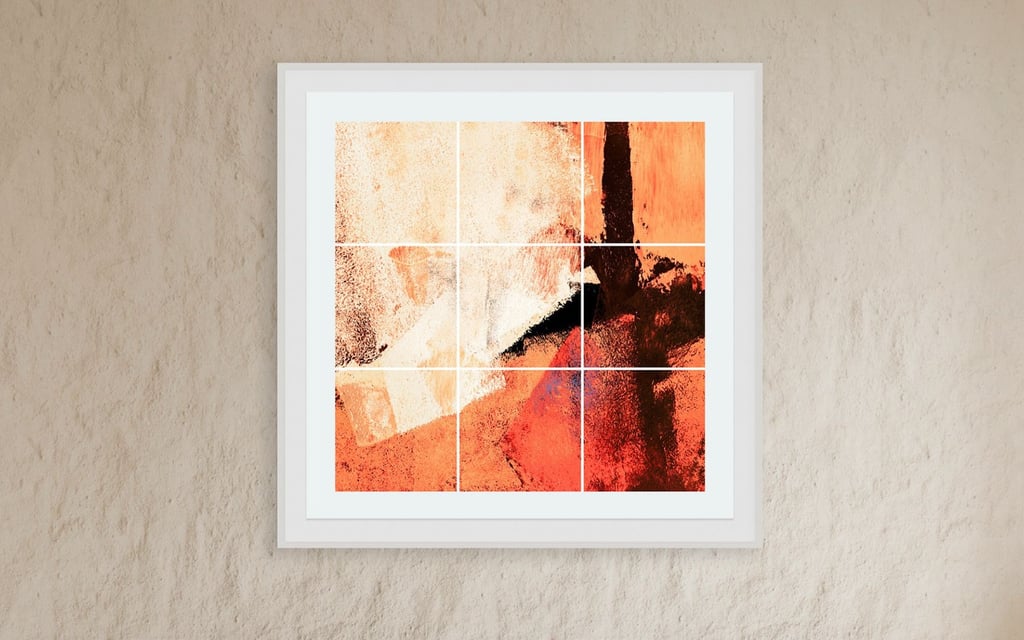
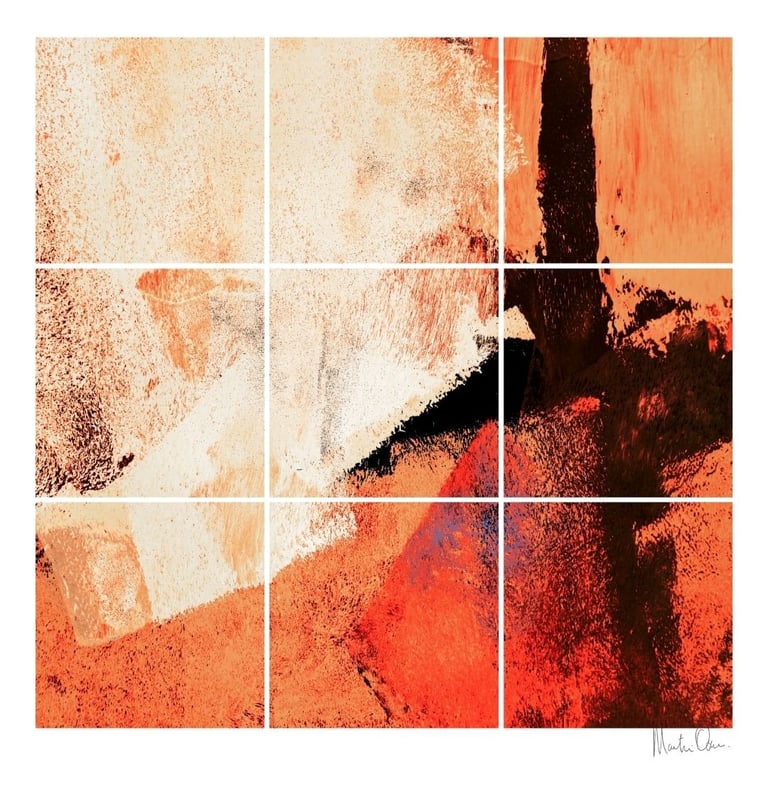
Analogous Anthology No. 7 (see above) came into being almost by accident. I was in the middle of a commission, and the paint roller still had colour left on it when the main work was done. Rather than clean it off and move on, I started rolling the excess onto spare paper nearby. At first, it was simply a practical thing to do — clearing the roller, not wasting what was left. But then something started happening on the surface. The layers built up. Shapes appeared where I hadn't planned any. Textures began talking to one another.
The original paint was in blue tones. But as I looked at what was forming, I felt the piece needed to go somewhere more intense — deeper into the spectrum. I shifted it toward orange and red, and that's when it found its identity. What began as leftover paint on scrap paper became one of the most energetic works in the collection.
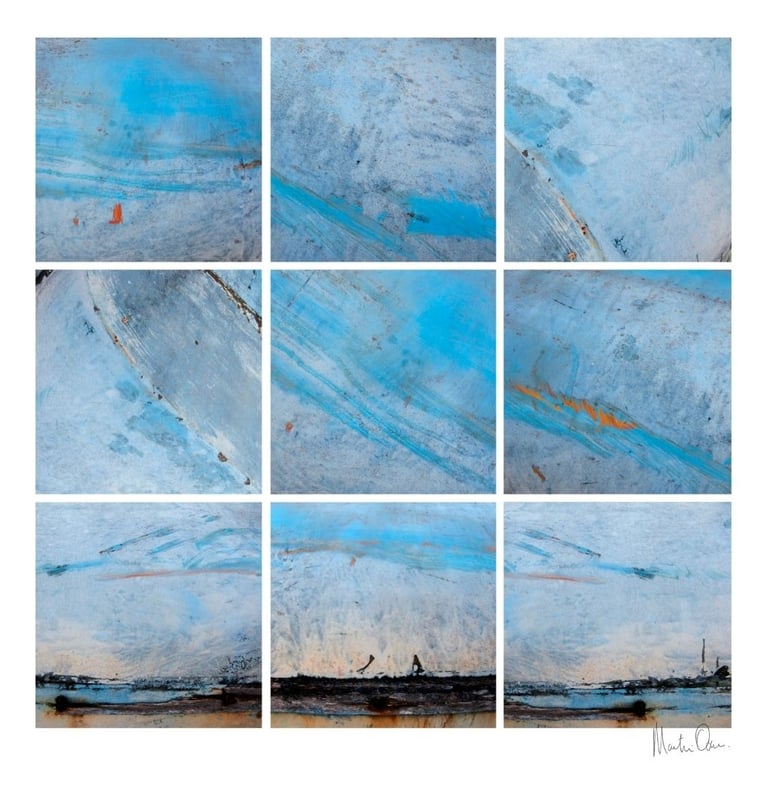
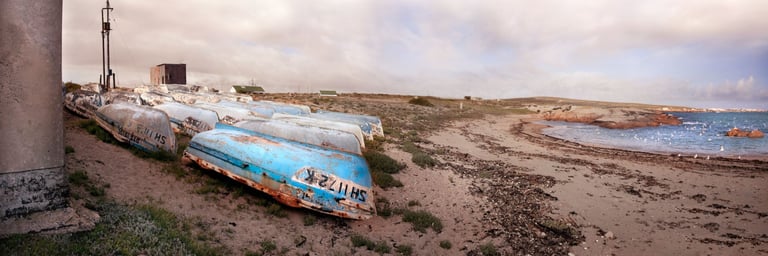
The series didn't start with paint rollers. It started with fishing boats pulled up on a beach, and a close look at what time and salt water do to a surface. What drew me in wasn't the boats as objects. It was the anti-fouling paint that had cracked and faded and peeled in the most extraordinary ways. The damaged gunwale of one boat — looked at a certain way — suggested the edge of a coastline, or the inlets of a harbour. I photographed the details selectively, not to document what the boats were, but to gather fragments I could later reassemble into something else entirely. In the finished work, Analogous Anthology No. 1, those aged surfaces became a Dutch harbour scene beneath a winter sky, with the last warmth of late light still sitting in the composition.
Where the collection began — weathered boats on a beach
I've always believed that art isn't found only in grand subjects or dramatic landscapes. It hides in the worn, the overlooked, the broken. A surface that most people would walk past can become — if you're paying the right kind of attention — the foundation of something lyrical.
"That's going to be a winner." — said my wife, looking at the piece before it was finished. She was right.
Back in 2013, I was running my first fine art photography gallery and working on Analogous Anthology No. 1 at the time. My wife came in to look at it. She doesn't naturally gravitate toward abstract work, so I've learnt to pay attention when something stops her. She looked at it for a moment and said exactly that. Over time, it became one of the top three best-selling works in the gallery's history. Only a few prints from the edition remain.
At the heart of this collection is a way of working that sits somewhere between photography and painting. Traditional photography is often about capturing a decisive moment — a scene as it is, framed within a single exposure. There's real value in that. But photographic montage offers a different possibility. It lets the lens shift from recording to interpretation. Rather than freezing reality, it reshapes it. The lens becomes a tool for gathering fragments: rhythms, textures, surfaces, impressions. These are then brought together to form something more expressive — and often more emotionally charged — than the original subject ever was. The end result still carries the DNA of photography, but it enters the space of fine art differently. It breathes differently. It asks the viewer not just to look, but to experience. That's what draws me to it. The photograph no longer has to behave like a window. It can become a constructed visual experience — one in which overlap, tension, imperfection, and movement are part of the image's language.
Why photographic montage matters
The lens becomes a tool for gathering fragments: rhythms, textures, surfaces, impressions. These are then brought together to form something more expressive — and often more emotionally charged — than the original subject ever was. The end result still carries the DNA of photography, but it enters the space of fine art differently. It breathes differently. It asks the viewer not just to look, but to experience. That's what draws me to it. The photograph no longer has to behave like a window. It can become a constructed visual experience — one in which overlap, tension, imperfection, and movement are part of the image's language.
Earth, Wind & Fire — and the beauty of not quite getting it right
At the heart of this collection is a way of working that sits somewhere between photography and painting. Traditional photography is often about capturing a decisive moment — a scene as it is, framed within a single exposure. There's real value in that. But photographic montage offers a different possibility. It lets the lens shift from recording to interpretation. Rather than freezing reality, it reshapes it.
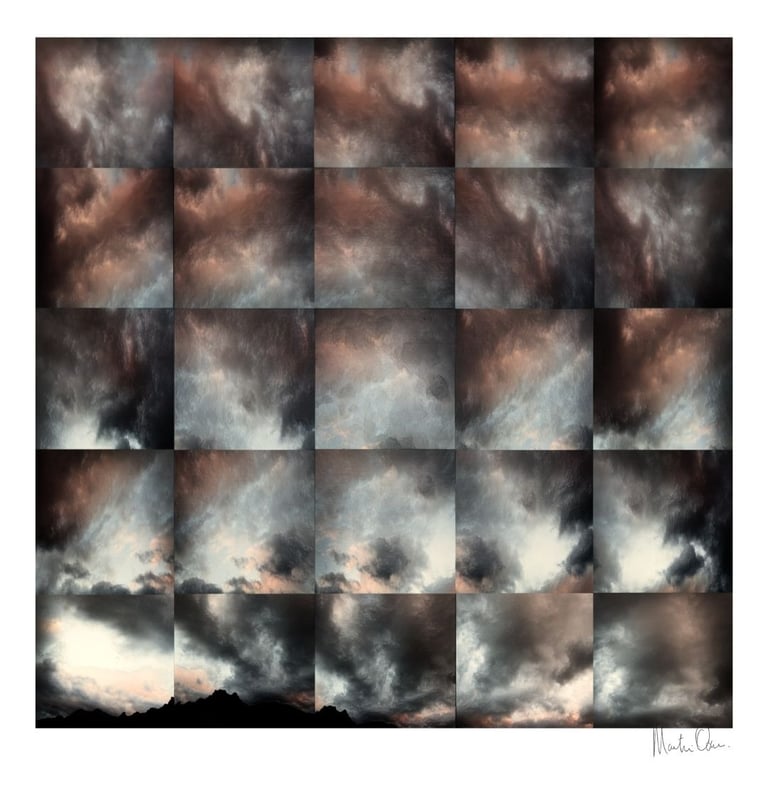
The resulting forms feel like they belong somewhere between landscape, reflection and dream. Nature isn't repeated for effect — it's transformed. Trees, branches and tonal shifts become imaginary islands with their own presence. They're illusions, but they don't feel false. They feel discovered.
Mirror Island — symmetry, stillness, and something imagined
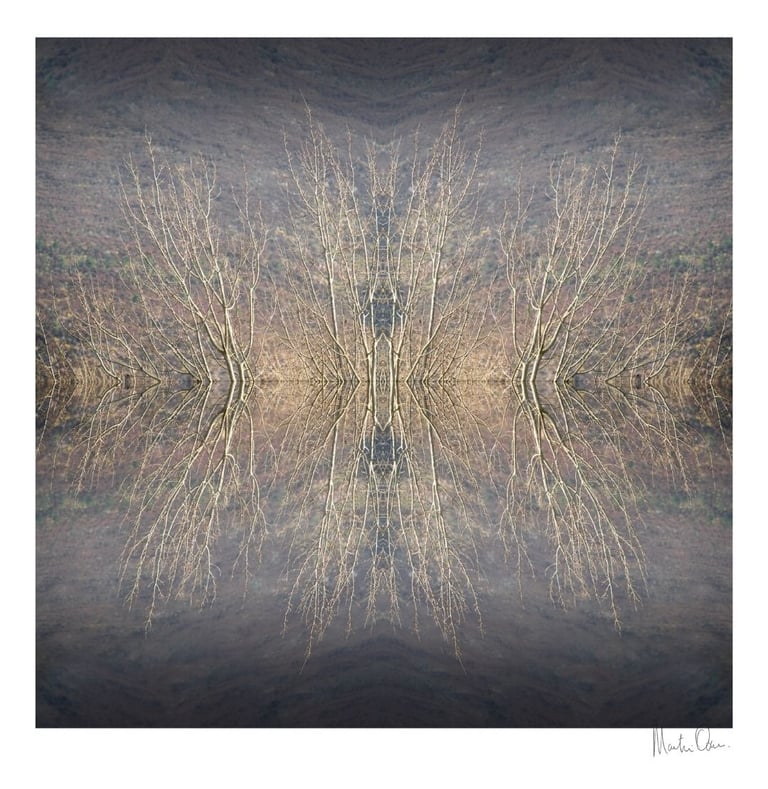
A very different mood appears in the Mirror Island series.
Here, the process is more symmetrical and contemplative. Photographs are mirrored to create the illusion of islands suspended in still water. It's playful, but it's also deeply peaceful. The nearest comparison I can find is something many of us did as children — folding a painted sheet of paper in half, opening it again, and finding something unexpected in the mirror. The principle is similar here, but worked photographically, and with much more control over structure, tone and mood.
Analogous Anthology, Earth, Wind & Fire, Mirror Island — what these series share isn't just technique. It's a willingness to depart from expectation. So much of the strongest work begins in an unplanned moment: leftover paint on spare paper, a cracked surface on a boat, a sky seen from the studio window in the last light of evening.
Experimentation isn't a luxury in the creative process. It's usually the door through which the best work enters. When we stop insisting that the lens must only describe reality, we begin to use it in a richer way — not to observe, but to construct. To paint with light, shape, rhythm and energy.
Analogous Anthology No. 7 is a reminder of that. It came out of process, out of movement, out of not wasting what was left behind. It's proof that creativity doesn't always arrive neatly and on cue.
Sometimes it appears in the margins of another task — waiting to be recognised.
What connects all of it
VISIT MARTIN'S ART GALLERIES
© 2025 Martin Osner Art. All Rights Reserved